Getting Started
Arizona Homeschool Affidavit: 2026 Filing Guide
How to file the Arizona homeschool affidavit correctly: county-specific forms, the certified birth certificate rule, the 30-day deadline, and why ESA and affidavit are separate legal paths.
8 min read · Updated
Spotlighted programs in this guide
 Featured
Trinity Arch Preparatory School for Boys
A Christian hybrid small school where boys grow in wisdom, character, and purpose. We partner with Christian homeschooling families to provide an exceptional education for boys ages 10–18. Through small tutorial groups, outstanding male mentors, rigorous academics including dual enrollment opportunities for high school students, daily physical training, and more than 15 expeditions each year, boys develop the confidence, discipline, and leadership needed to flourish. School at Trinity Arch looks different from a traditional classroom. Boys spend their days in small tutorial groups with expert tutors who know them personally, engage in rigorous academics, participate in Socratic discussions, pursue independent "Deep Think" projects, play chess, train physically each day, and explore Arizona through expeditions. Our goal is to cultivate young men who love learning, embrace responsibility, and are prepared to lead lives of faith, service, and purpose. Every family is different. We offer flexible scheduling options and work alongside parents to design a program that complements their homeschooling journey. Many families qualify for significant scholarship assistance, making a Trinity Arch education more affordable than they might expect. We intentionally limit enrollment so every boy is truly known, challenged, and encouraged. If you're looking for a Christ-centered community where your son can flourish academically, physically, socially, and spiritually, we'd love to meet your family.
 Featured
Little Risers Schoolhouse
Little Risers Schoolhouse is a faith-based, back-to-basics school located in Surprise. Our mission is to help raise the next generation to know the Lord, in education, and life skills! We begin each day with the pledges, Bible time, and standard-based academics to build a strong educational foundation for every child. After academics, we transition into hands-on life skills learning, where students engage in meaningful activities such as gardening, caring for our farm animals, cooking, sewing, and more. Our goal is to nurture the whole child academically, spiritually, and practically by helping them grow in knowledge, character, and real-life skills. We offer a full-time program Monday through Friday from 8:00 AM to 3:00 PM, with before and aftercare available for families who need additional flexibility.

The arizona homeschool affidavit is a one-time, notarized document filed with your county school superintendent that legally establishes your homeschool under Arizona law. Under A.R.S. § 15-802, parents must submit this affidavit within 30 days of beginning home instruction. The Arizona Department of Education plays no role in this process. Many parents assume they register with the state or their local school district. They do not. The county superintendent is the only correct filing office, and getting that detail right from the start protects your family from unnecessary legal complications.
What is the Arizona homeschool affidavit and what documents do you need?
The affidavit of intent to homeschool is the formal name for what most parents call the Arizona homeschool form. It is a sworn, notarized statement declaring that you are providing home instruction to your child. The affidavit must include the child's legal name, date of birth, current address, and parental contact information. You submit it once, and no annual renewals are required after that.
Gathering the right documents before you file prevents delays and rejections. The required supporting documents are:
- County-specific affidavit form. Each county publishes its own version with legally required checkboxes and wording. Generic affidavit forms are a leading cause of rejection. Download the form directly from your county superintendent's website.
- Certified birth certificate. Per A.R.S. § 15-828(B), you must include a certified copy issued by a vital records office. Hospital birth certificates are not accepted and will cause your filing to be delayed or returned.
- Notarized signature. The affidavit must be notarized before submission. Banks, UPS stores, and some county offices provide notary services, often at no cost.
Pro Tip: Keep a scanned copy of every document you submit, including the notarized affidavit and the certified birth certificate. If a county office ever questions your filing date, that digital record is your best protection.
Once you have all documents ready, use certified mail with return receipt or an online portal where available. Certified mail creates a verifiable proof of compliance that protects you if any dispute arises over your filing date.

How do you file the homeschool affidavit in Arizona counties?
Filing procedures vary by county, but the legal deadline is the same statewide. You must submit your affidavit within 30 days of the date your child begins home instruction. Missing that window can trigger truancy accusations under Arizona compulsory attendance law.
The step-by-step process for most Arizona counties looks like this:
- Obtain the correct form. Visit your county school superintendent's website and download the affidavit of intent specific to your county.
- Complete all required fields. Fill in the child's legal name, birthdate, address, and your contact information. Leave no fields blank.
- Get the affidavit notarized. Sign the document in front of a licensed notary. Some county offices offer free notary services during business hours.
- Attach a certified birth certificate. Include the sealed, certified copy from a vital records office. Do not substitute a hospital-issued copy.
- Submit to your county superintendent. Choose from the options your county offers: online portal, certified mail, or in-person drop-off.
- Retain proof of submission. Keep your certified mail receipt, online confirmation number, or date-stamped copy for your records.
County filing methods differ in meaningful ways. The table below summarizes what parents can expect across key Arizona counties.
| County | Filing method | Notes |
|---|---|---|
| Maricopa | Online via Homeschool Connect portal | Homeschool Connect is the county's dedicated system |
| Pima | Mail or in-person | Free notary available at the superintendent's office |
| Coconino | Mail or in-person | Contact office to confirm current procedures |
| Yavapai | Confirm mailing address on county website before sending | |
| Mohave | Mail or in-person | In-person appointments recommended for first-time filers |
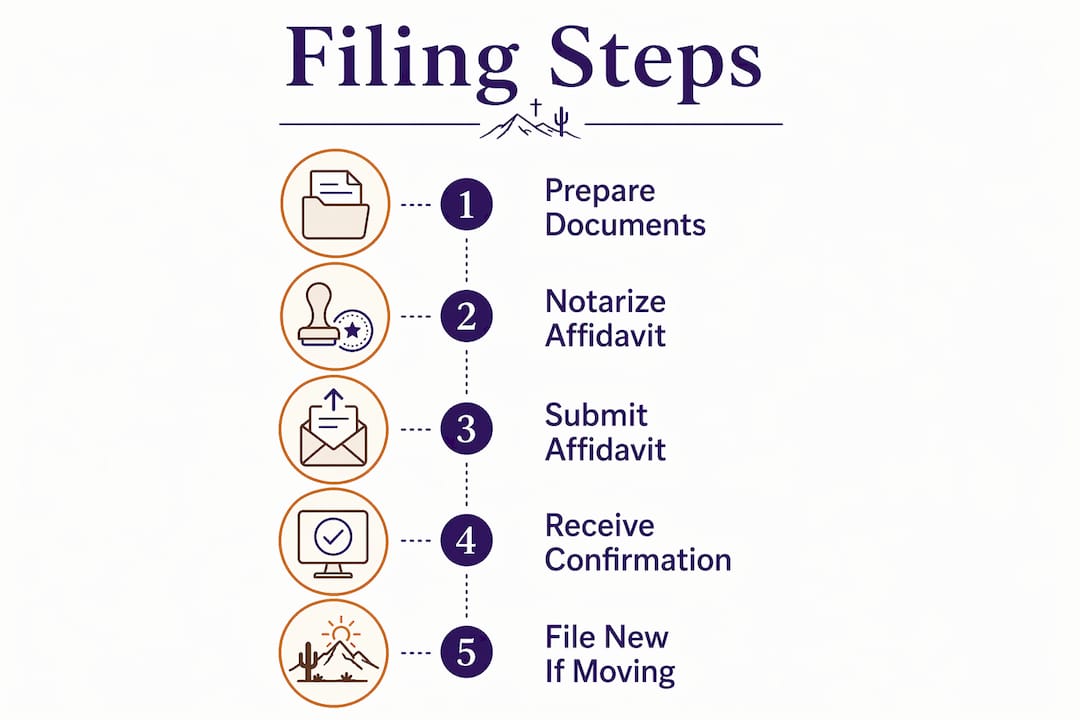
Most counties do not send a confirmation letter after receiving your affidavit. That silence is normal. Keep your own records rather than waiting for official acknowledgment.
If you move to a new county after filing, you must file a new affidavit with the superintendent in your new county. If you stop homeschooling and later resume, file again at that time. The one-time rule applies per continuous homeschool period, not per child's lifetime.
What are your legal obligations after filing the affidavit?
Arizona law is notably light on ongoing requirements for homeschooling families. Arizona requires instruction in five core subjects: reading, grammar, mathematics, social studies, and science. Beyond those five subjects, the state imposes no curriculum approval process, no standardized testing mandate, and no teaching credential requirement for parents.
"Homeschooling under a county affidavit in Arizona offers one of the least restrictive homeschool environments in the country, maximizing family autonomy with minimal government oversight. Parents choose their curriculum, set their schedule, and direct their child's education without state interference beyond the initial filing."
Compulsory attendance law in Arizona applies to children ages 6 through 16. Once your child turns 16, the legal obligation to maintain homeschool status ends, though many families continue voluntarily. You do not need to submit attendance records, lesson plans, or annual reports to any government office.
The distinction between affidavit homeschooling and Arizona's Empowerment Scholarship Account program matters greatly. ESA participants are classified under a separate legal category with different reporting requirements. Filing a homeschool affidavit while actively participating in the ESA program violates state law. You must choose one path. Families using ESA-approved curriculum through the scholarship program follow a different compliance process entirely.
If you decide to stop homeschooling and enroll your child in a public or private school, notify your county superintendent's office in writing. Keeping that correspondence on file protects you from any gap in attendance records.
Common mistakes to avoid when filing your affidavit
Most filing problems are preventable. The errors below account for the majority of delays, rejections, and legal complications Arizona homeschooling families face.
- Missing the 30-day deadline. Failing to file within 30 days of starting homeschooling can trigger unexcused absence reports and Department of Child Safety inquiries. File on day one if possible.
- Filing with the wrong office. Submitting to the Arizona Department of Education or your local school district is a common error. The county school superintendent is the only correct recipient.
- Using a hospital birth certificate. Only a certified, sealed copy from a vital records office satisfies the A.R.S. § 15-828(B) requirement. A hospital-issued document will result in rejection.
- Using a generic affidavit form. County-specific forms contain legally required language and checkboxes. A generic form downloaded from a non-county source will likely be rejected.
- Confusing affidavit filing with ESA enrollment. These are two separate legal pathways. Legal experts emphasize that parents must choose one path to avoid compliance issues.
- Failing to withdraw your child from school properly. Notify the school in writing before or on the day you begin homeschooling. Keep a copy of that notice.
- Not keeping proof of filing. Some counties provide no receipt or confirmation. Use certified mail with return receipt, or save your online portal confirmation number.
Pro Tip: If a county office sends a follow-up request for additional documentation, respond in writing within the timeframe they specify. Keep a copy of your response and any supporting documents you send. Prompt, documented replies prevent minor requests from becoming compliance problems.
Connecting with a local homeschool co-op early in the process gives you access to parents who have already navigated these steps in your specific county. That community knowledge is practical and current.
Key Takeaways
Filing the Arizona homeschool affidavit correctly the first time protects your family from truancy issues and keeps your homeschool legally established under A.R.S. § 15-802.
| Point | Details |
|---|---|
| File within 30 days | Submit your notarized affidavit to the county superintendent within 30 days of starting home instruction. |
| Use county-specific forms | Generic forms are rejected; download the affidavit directly from your county superintendent's website. |
| Certified birth certificate required | Only a sealed copy from a vital records office satisfies A.R.S. § 15-828(B); hospital copies are not accepted. |
| No ongoing state reporting | Arizona requires no annual renewals, standardized testing, or attendance records after the affidavit is filed. |
| ESA and affidavit are separate paths | Filing both simultaneously violates state law; choose one legal classification for your homeschool. |
Why Arizona's affidavit system is worth understanding deeply
Arizona's homeschool framework is genuinely one of the most family-friendly in the country. I have seen parents in other states spend weeks navigating curriculum approval boards and annual portfolio reviews. In Arizona, you file once, teach five subjects, and the state largely leaves you alone. That freedom is real, and it is worth protecting by getting the paperwork right.
The detail that catches most families off guard is the birth certificate requirement. Parents assume the document they received at the hospital is sufficient. It is not. Ordering a certified copy from the Arizona Department of Health Services or your county vital records office takes a few days and a small fee. Build that step into your timeline before you start teaching.
Recordkeeping matters even when the state does not require it. I keep a dedicated folder with the original notarized affidavit, the certified mail receipt, and every piece of correspondence with the county office. If a question ever arises about when we started homeschooling or whether we filed on time, that folder answers it immediately. The state may not ask, but a neighbor, a relative, or a local official occasionally will.
Finally, connecting with your local Christian homeschool community changes the experience entirely. Other families in your county have already solved the problems you are about to face. They know which county offices are responsive, which forms have changed recently, and which microschool programs work well alongside affidavit-based homeschooling. That network is worth more than any checklist.
— Grant
Arizonachristianhomeschools supports your homeschool from day one
Once your affidavit is filed and your homeschool is legally established, the next step is building a curriculum and community that fits your family's faith and goals.

Arizonachristianhomeschools connects Arizona families with Christ-centered homeschool curriculum options including classical, unit-study, and textbook-based programs. The directory also lists co-ops and microschools across the state where children build friendships, complete group projects, and participate in enrichment activities. All programs listed are compatible with affidavit-based homeschool legal status, so you can add community and structure without changing your legal classification.
FAQ
What is the Arizona homeschool affidavit?
The Arizona homeschool affidavit, formally called the affidavit of intent to homeschool, is a notarized document filed with your county school superintendent that legally establishes your home as a school under A.R.S. § 15-802. It is a one-time filing with no annual renewal required.
Where do I file the homeschool affidavit in Arizona?
File the affidavit with your county school superintendent, not the Arizona Department of Education or your local school district. Maricopa County uses the Homeschool Connect online portal; other counties accept mail or in-person submissions.
What happens if I miss the 30-day filing deadline?
Missing the deadline can trigger unexcused absence reports and Department of Child Safety inquiries under Arizona compulsory attendance law. File as early as possible, ideally on the first day your child begins home instruction.
Can I file a homeschool affidavit and use the ESA program at the same time?
No. ESA participants are classified under a separate legal category, and filing a homeschool affidavit simultaneously violates state law. Choose one path and follow its specific compliance requirements.
Do I need to renew the affidavit every year?
No. The affidavit is a one-time filing. You only need to file again if you move to a different county or stop and later resume homeschooling.
New to all of this? Start with How to Start Homeschooling in Arizona: The Complete Guide.
Frequently Asked Questions
What is the Arizona homeschool affidavit?▼
Where do I file the homeschool affidavit in Arizona?▼
What happens if I miss the 30-day filing deadline?▼
Can I file a homeschool affidavit and use the ESA program at the same time?▼
Do I need to renew the affidavit every year?▼
Part of the Laws & getting started hub
Arizona Homeschool Laws
The affidavit, ARS §15-802, required subjects, and how ESA changes your legal classification.
More from the Laws & getting started hub
- Homeschool vs. ESA in Arizona: Know the Legal Difference (2026)
Homeschooling (ARS §15-802) and ESA-funded education are two different legal pathways in Arizona. Here's how they differ, why it matters, and how to choose.
- Arizona Homeschool Laws: The Complete Guide for Christian Families (2026)
Arizona homeschool law explained for Christian families: the affidavit, the 30-day rule, required subjects, testing, ESA vs. homeschool, and returning to public school.
- How to Start Homeschooling in Arizona: The Complete Guide (2026)
Homeschooling in Arizona, step by step: the affidavit, ARS §15-802, the five required subjects, ESA funding of ~$7,000-$8,000, curriculum picks, and finding community.
- Homeschool Schedule: Sample Daily Schedules by Age (2026)
Sample homeschool daily schedules for kindergarten through high school, plus four-day weeks, block and loop schedules, and how many hours a day homeschooling really takes.
This guide is general information, not legal, tax, or financial advice. Confirm current rules with the Arizona Department of Education before acting.