Curriculum & Method
Homeschool Bible Curriculum: 18 Programs Compared by Grade, Price, and Format (2026)
Compare 18 homeschool Bible curricula by grade, price per child, format, family vs. independent learning, translation, and doctrine — with 2026 publisher pricing and Arizona ESA guidance.
24 min read · Updated
Spotlighted programs in this guide
Amor Dei Academy - Tempe
Amor Dei Academy is a Christian K–12 academic and enrichment homeschool drop off program offering classes from 9:00am - 4:00pm. Families can choose from flexible à la carte classes designed to fit their homeschool needs, with engaging academic and enrichment options available for every grade level.
Finding a homeschool Bible curriculum means balancing what you believe, how your children learn, and how much time you have to teach. A workbook that works for an independent eighth grader may be a poor fit for a family trying to teach three younger children together. This guide compares 18 options, including one Scripture-practice supplement, with publisher pricing checked where possible on October 17, 2026.
Quick answer: For mixed ages, start by comparing Answers Bible Curriculum, Bible Study Guide for All Ages, Grapevine Studies, and Treehouse Schoolhouse Rooted. For a traditional grade-by-grade course, look at BJU Press, Abeka, or Positive Action for Christ. If you need free lessons, start with Calvary Curriculum or Easy Peasy.
About this comparison: Listed prices refer to the specific edition or component named, not necessarily a complete year's cost. A price to verify is deliberately not an estimate. The publisher links are included so you can check the current edition, samples, licenses, and total cart price. We have not personally classroom-tested all 18 programs, and we do not present sample descriptions as first-hand reviews.
Homeschool Bible curriculum compared
Prices and availability last reviewed October 17, 2026. “From” identifies an example product, not the cost of a complete program. The rows labeled “Confirm price” need a current publisher quote for the specific edition or bundle.
No matches. Try loosening the price, translation or doctrinal filter. Unknown details are not treated as a match to a specific claim.
| Program | Best-fit ages or grades | Price example (USD) | Structure and format | Family or independent? | Bible translation / important note |
|---|---|---|---|---|---|
| Memoria Press Christian Studies | 3–6 (Christian Studies I–III); IV for 6–8 | $57.35, Christian Studies I set; three-year bundle price should be confirmed | Classical; 30 lessons per level | Parent-led, individual written work | Bible-story reader and memory passages; review wording |
| Abeka Bible | Elementary and upper-grade options | $16.50, older grade 3 plan; complete kit confirm price | Bible stories, songs, memory, teacher materials | Parent-led, grade-specific | KJV prominent in Scripture memory; check edition |
| BJU Press Bible | 1–12 | $118.10, Bible 2: Truths for Life textbook kit | Lessons, student worktext, tests | Grade-specific; video options | Translation varies by course; edition matters |
| Answers Bible Curriculum Homeschool | K–5 | $39.99 teacher guide; $39.99 student book with tests | 36 weeks per year, four-year cycle | One lesson with differentiated student books | Explicit young-earth creation perspective |
| Apologia The Word in Motion | K–8 | $55 per Old or New Testament textbook; journals extra | Two-volume OT/NT survey; movement and notebooking | Family, with different levels of follow-up | Check references in lesson sample |
| Bible Study Guide for All Ages | Preschool–adult | $19.95 PDF Unit Teacher’s Guide; student sets extra | 416 lessons; maps, timelines and worksheets | Same core Bible topic at several levels | Flexible Bible choice; some student pages quote NIV |
| Grapevine Studies | PreK–9 depending on level | $49.95 NT teacher ebook + $23.95 family-level student ebook | Stick-figure timelines and Bible drawing | Excellent multi-age family format | Use family Bible; study license carefully |
| SchoolhouseTeachers.com | PreK–12 | $389/year for full-subject family membership | Multiple online/printable courses | Options for several children | Bible content varies by course |
| Calvary Curriculum | Preschool–6 | Free, original 325-lesson children's series | Downloadable Bible studies and worksheets | Parent-led | NKJV in English; distinguish free series from membership materials |
| Bible Road Trip | Preschool–high school | Free sample available; full program price confirm | Three-year Bible survey, notebooking | Family | Do not confuse a free sample with a full free course |
| Easy Peasy All-in-One | 1–8; separate high school offerings | Free online | Old Testament, New Testament, Poetry, Prophets | Mostly independent once reading-ready | External links and optional printed books |
| Sonlight Bible | Preschool–12 | $27.98 Bible A book collection; $42.98 Bible B | Reading, missions, memory songs, discussion | Family read-aloud early; increases independence | Standalone collections may rely on a separate Sonlight Instructor's Guide schedule |
| Positive Action for Christ | PreK–12 across series | $20.95 Finding God's Promises student manual + $54.95 print teacher manual | Weekly structured Bible study | Grade-level, teacher-led | Review doctrinal content and memory version |
| Telling God's Story | Elementary for published Year One | Confirm publisher price | Gospel narratives, scripted instructor text, activity guide | Parent-led | Peter Enns's theological approach warrants a closer look |
| Treehouse Schoolhouse Rooted | K–8 (two age levels) | From $45, format dependent | 18 weeks of Scripture, hymns, poetry, art and reflection | Family | Thematic formation rather than book-by-book survey |
| Not Consumed Bible Studies | Ages 4 through teens and parent | $15 per printed Bible Basics level or parent guide | 20-day topical studies | Coordinated family, separate age books | Uses ESV in preparation but designed for use with other translations |
| Master Books Bible/worldview resources | Varies by title | Confirm specific Bible title and price | Biblical worldview across multiple subjects; separate books | Depends on product | Not one standardized, standalone K–12 Bible sequence |
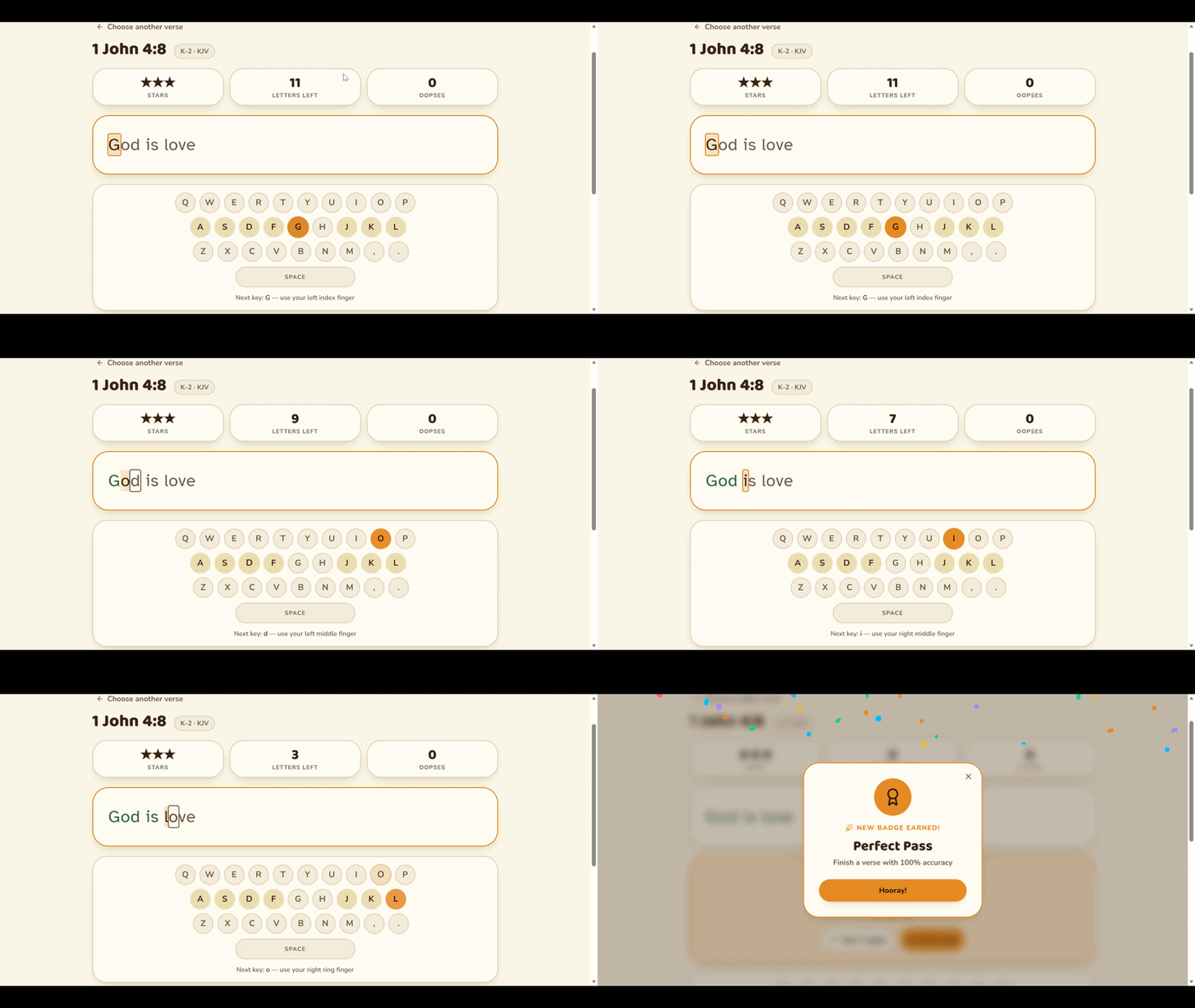
| Typing Scripture (publisher-owned supplement) | K–8 (per creator's outline) | Price not supplied | Scripture typing and verse practice | Independent supplement | KJV default; not a full Bible course |
Which one should you look at first?
For a busy parent teaching three grades, choose the program based on who is sitting at the table. A shared Bible lesson followed by different levels of response usually saves more preparation time than three unrelated grade-level lesson plans. For a student who needs written accountability or a formal grade, a structured worktext may be easier to document.
A Bible curriculum should tell you what to teach next. A devotional helps you reflect on Scripture. A memory or typing tool helps reinforce verses. They may complement one another, but they do not do the same job.
What does homeschool Bible really cost per child?
Consider a parent with one, two, or three eligible-age students studying the same year's content. These are transparent examples of the initial purchase, not claims that all three students can use every edition identically. Shipping, taxes, optional supplies and future years are excluded.
| Example setup | One child | Two children | Three children | What we counted |
|---|---|---|---|---|
| Calvary Curriculum original downloads | $0 | $0 | $0 | Free digital study series; home printing extra |
| Answers Bible Curriculum Year 1 | $79.98 | $119.97 | $159.96 | One $39.99 teacher guide + one $39.99 student book-with-tests per child |
| BJU Press Bible 2 textbook route | $118.10 | $153.66 | $189.22 | One $118.10 textbook kit + one $35.56 student worktext per additional child; verify other consumables needed |
| Positive Action, Finding God's Promises | $75.90 | $96.85 | $117.80 | One $54.95 printed teacher manual + $20.95 student manual per child |
| Grapevine NT digital, one shared level | $73.90 | $73.90 | $73.90 | One $49.95 teacher ebook + one $23.95 student family license for children at same level |
| SchoolhouseTeachers Ultimate Annual | $389 | $389 | $389 | One annual family membership covering Bible and all other available subjects |
What the numbers mean: A family-license download can be especially attractive when siblings use the same activities, but children at different Grapevine levels may require separate family-level student ebooks. BJU's textbook kit is not the same thing as a video course. SchoolhouseTeachers is a whole-homeschool subscription, so judging its value on Bible alone would be misleading. Before ordering, check how many student workbooks you need, whether the teacher guide is reusable, and what a particular license permits. Answers pricing, BJU pricing, Positive Action pricing, Grapevine family license, SchoolhouseTeachers pricing.
Family study or independent work?
Family-style Bible starts with a common passage, story or theme. Everyone listens or reads together, then a preschooler draws, a third grader answers questions, and an eighth grader writes or researches. Answers Bible Curriculum, Grapevine Studies, Bible Study Guide for All Ages, Apologia's The Word in Motion, Treehouse Rooted, and Not Consumed fit this approach in different ways.
Independent or grade-specific Bible usually gives one student a defined sequence of pages, assignments and assessments. BJU Press, Abeka, Positive Action for Christ, and Easy Peasy are worth considering. These can be easier to assign without coordinating siblings, but teacher-led programs still require parent instruction even when the child has a workbook.
Ask three questions before you buy: Can all your children hear the same passage? Are the student pages reproducible or individually purchased? And do you want a lesson that ends with conversation or with something you can grade?
Best homeschool Bible curriculum by grade
Preschool and kindergarten
At this age, prioritize listening, retelling, simple questions, pictures and short memory verses. You do not need a thick workbook to build biblical literacy.
Start with: Calvary Curriculum for printable stories; Grapevine PreK–K for visual repetition; Bible Study Guide for All Ages for age-level activities; Memoria Press Christian Studies Enrichment for a gentler read-and-discuss path.
A useful daily rhythm: Read a short Scripture or story passage; ask who was there and what happened; let the child tell it back or draw it; pray. Ten focused minutes can be more productive than a half-hour battle over pencil work.
Elementary (grades 1–5)
This is a strong time to move from isolated stories into the larger Bible narrative: creation, fall, covenant, law, prophets, Jesus, the early church and Christian living.
Start with: Answers Bible Curriculum for a clearly sequenced family curriculum; Abeka for stories, memory and repetition; BJU Press for worktexts and formal exercises; Memoria Press for a classical, chronological approach.
If one child loves crafts and another wants factual questions, shared teaching followed by different outputs is often the compromise that lasts all year.
Middle school (grades 6–8)
Older students can begin explaining a Bible passage in context rather than only retelling the events. Ask them to find the audience, summarize the author’s point, compare cross-references, and explain how a Christian doctrine follows from Scripture.
Start with: Apologia The Word in Motion for broad Old and New Testament study; Positive Action Route 66 for a more structured survey; Grapevine for siblings working at different difficulty levels; Memoria Press Christian Studies IV for review and biblical chronology.
High school (grades 9–12)
Look for material that supports close reading, history, worldview, interpretation and written analysis. If you plan to record a credit, select a course with a sufficiently substantial scope and keep evidence of what the student completed.
Start with: Sonlight's upper-level Bible sequence, Positive Action's upper-grade studies, SchoolhouseTeachers, or Easy Peasy High School's Bible 1–4. Review course descriptions carefully: a helpful devotional is not necessarily enough work to justify an entire transcript credit.
Individual homeschool Bible curriculum reviews
These are practical product assessments based on published course structures and product descriptions, not claims that we taught these programs in our home.
1. Memoria Press Christian Studies
Best for: Families who enjoy classical education, biblical chronology, memorization and structured discussion. Christian Studies I–III use The Golden Children's Bible and guide students through major passages over three levels. Each student guide includes memory work, vocabulary, factual questions and maps; the teacher guide adds context and discussion prompts. Christian Studies I's current publisher listing shows a $57.35 set for grades 3–6. View Christian Studies I and samples.
The trade-off: The academic tone suits children comfortable with reading and writing better than those who need movement or crafts. Confirm which book, flashcards and optional plans are included in your chosen set.
2. Abeka Bible
Best for: Families who prefer traditional lesson plans, story illustrations, hymns and Scripture memory. Abeka offers grade-specific Bible materials, with flash-card stories and teacher-guided reviews. The linked older grade 3 curriculum plan is $16.50, but it is not a complete Bible kit price. View Abeka's grade 3 component.
The trade-off: The full experience can require multiple components, and kit editions change. Compare current teacher materials, student materials and streaming options instead of assuming an old bundle price still applies. Its traditional Baptist/Protestant teaching and KJV-oriented memory work are not neutral choices for every Christian family.
3. BJU Press Bible
Best for: Parents who want clearly identified learning objectives, tests and student worktexts. Bible 2: Truths for Life includes doctrine, Bible narrative and application exercises. Its subject textbook kit was listed at $118.10 on the publisher's grade 2 page, while the student worktext was $35.56. View Bible 2 options.
The trade-off: A grade-specific textbook sequence is less convenient when several ages share Bible time. BJU has both Bible Truths and Bible: Truths for Life editions in circulation, so match your teacher guide and worktext carefully.
4. Answers Bible Curriculum Homeschool
Best for: Families seeking an explicitly creation-focused, chronological Bible program with one parent-led lesson and differentiated assignments for K–5. Its four-year plan uses 36 weeks a year. The publisher currently lists the Year 1 teacher guide at $39.99 and student books with tests at $39.99 per level. View the homeschool editions.
The trade-off: A young-earth creation viewpoint is integral to this publisher's identity. This is an advantage for families who share it and a reason to read samples carefully if your beliefs differ. The complete curriculum is not free, even though samples and other ministry resources may be.
5. Apologia: The Word in Motion
Best for: Hands-on families who enjoy notebooking, memorization and seeing how Old and New Testament books connect. There are separate Old Testament and New Testament volumes recommended for K–8. The publisher lists the Old Testament textbook at $55, with notebooking journals purchased separately; bundles vary. View the Old Testament book and sample.
The trade-off: The engaging, shared approach does not automatically deliver formal high-school-level coursework. Compare textbook and journal costs before calculating a budget for several siblings.
6. Bible Study Guide for All Ages
Best for: Parents who want the same passage taught at different developmental levels. Its 416 lessons are grouped into four units, with younger and older student pages, teacher guides, maps and timelines. A PDF Unit Teacher's Guide costs $19.95; printed books and student materials are extra. See its lesson-by-lesson sequence and teacher guide.
The trade-off: There are many components and levels to choose from. Ordering can take longer than selecting a simple boxed kit, and siblings may need different student page sets.
7. Grapevine Studies
Best for: Visual learners and parents teaching mixed ages together. The signature method is stick-figure drawing: read Scripture, sketch the people and events, and review a growing timeline. For the New Testament digital family materials, one Master Teacher ebook is $49.95 and each level's family student ebook is $23.95. View the family-license components.
The trade-off: The drawing routine may feel repetitive to a child who wants deeper written study. Be careful to select the correct family license rather than a classroom license, and budget for additional levels if siblings span different age groups.
8. SchoolhouseTeachers.com
Best for: Families that want Bible alongside many other homeschool subjects in one membership. The listed Ultimate Annual plan is $389 for the whole family and provides access to hundreds of courses across subjects and grades. See current membership pricing.
The trade-off: This is more than a Bible purchase and is poor value if you only need one stand-alone Bible course. Check the particular Bible course's teacher involvement, materials and doctrine separately; a platform-wide membership does not make every course interchangeable.
9. Calvary Curriculum
Best for: Free, printable Bible learning, especially younger elementary children. Calvary's site says its original 325 Children's Bible Study Support lessons, covering Genesis through Revelation for approximately first through sixth grade, remain available free; English materials use the NKJV. It also advertises membership-based materials and a preschool series. See the free-series description.
The trade-off: You provide the teaching, Bible reading and paper. Do not assume the entire current Calvary catalog is free because the original 325 lessons are.
10. Bible Road Trip
Best for: Families that want a multi-year tour of Scripture with notebooking, memory and cross-curricular resources. Its program is organized as a three-year biblical survey with age-differentiated ideas. See the creator's program description and free sample.
The trade-off: At the time of review, a free sample was confirmed, not an ongoing free license for the entire three-year course. Check the publisher's current downloads and purchase options before calling it a free curriculum.
11. Easy Peasy All-in-One Homeschool
Best for: Families who need a genuinely free, online lesson sequence. Easy Peasy offers Old Testament, New Testament, Poetry and Prophets courses for younger learners, and its separate high-school site lists Bible 1–4. The creator describes the online material as free; optional printed books are not required. Elementary courses and high school Bible.
The trade-off: It depends on online assignments and sometimes external resources. Parents should preview linked media and adapt the reading load for their children.
12. Sonlight Bible
Best for: Literature-rich homeschools where reading and discussing Scripture is part of the same daily rhythm as history and read-alouds. Sonlight's Bible A book collection costs $27.98, Bible B $42.98, and the publisher describes a progression through upper-level apologetics and worldview study. See the Bible sequence and Bible B components.
The trade-off: A Bible book collection is not always a self-contained lesson schedule. Sonlight says Bible readings are scheduled in its History/Bible/Literature Instructor's Guide, so budget for the guide if you do not already use Sonlight.
13. Positive Action for Christ
Best for: Parents who want formal lessons, Bible questions and a clear record of completed work. Finding God's Promises has 35 lessons and lists a $20.95 student manual plus $54.95 printed teacher manual. Route 66 for middle grades has 70 lessons and a $22.95 student manual, with the teacher's book extra. View Finding God's Promises and Route 66.
The trade-off: Written exercises and teacher manuals increase both structure and cost. Check the theological perspective, including issues such as salvation, baptism and church teaching, before selecting a course.
14. Telling God's Story
Best for: Elementary families interested in Gospel narratives and Jesus' teaching, with explanations written for the parent and activities for children. Peter Enns's Year One: Meeting Jesus centers on Gospel passages and provides an instructor text and separate student activity guide. Read the program overview.
The trade-off: Its author and interpretive approach can be a poor match for some conservative or young-earth families. Read the sample and the author's explanations yourself rather than relying on broad labels. Current publisher pricing for the exact set still needs confirmation.
15. Treehouse Schoolhouse: Rooted
Best for: A gentler morning-time Bible study that uses beauty, music, prayer and family discussion. Rooted is an 18-week study for primary and intermediate years with topics such as identity, devotion and wisdom. The publisher lists options from $45 and offers a free sample week. See Rooted and the sample.
The trade-off: Eighteen weeks will not automatically fill a full 36-week year. You may prefer to pair it with regular Bible reading or a second study, and should confirm the format and family-printing license.
16. Not Consumed Bible Studies
Best for: Families who want to study one topic together while each child completes age-appropriate questions. Bible Basics covers 20 days with primary, junior, youth and parent editions. Each printed level or parent guide is listed at $15. The publisher says it uses ESV in preparing studies but designs questions for multiple Bible translations. See Bible Basics.
The trade-off: It is a series of focused studies rather than a fixed year-by-year Bible survey. A parent teaching several ages may need several books, so calculate the whole cart.
17. Master Books Bible and worldview resources
Best for: Families already using Master Books who want Scripture connected with science, history, literature and Christian worldview studies. Master Books builds a biblical worldview into its academic products, but the catalog should not be mistaken for a single standardized K–12 Bible course. Browse its current curriculum.
The trade-off: Choose a specific title and examine its scope before labeling it your family's Bible class. We did not confirm an apples-to-apples stand-alone Bible kit price for this table.
18. Typing Scripture (Scripture-practice supplement)
Best for: Elementary and middle-grade students who need keyboard practice and an additional way to encounter or memorize Scripture. The creator's outline describes KJV-default Scripture typing for roughly K–8.
The trade-off: Typing verses is a useful supplement, not a replacement for teaching biblical context, theology, discussion and reading. Editorial disclosure: This is a product affiliated with the publisher of this guide. Its current price, actual product URL and course length were not provided, so we have not assigned a price or counted it as a complete curriculum.
Free homeschool Bible curriculum: what is actually free?
Calvary Curriculum: The original set of 325 elementary Bible studies can be downloaded for free according to Calvary's own site. Membership materials are a separate question. Calvary's explanation.
Easy Peasy All-in-One: Elementary Bible lessons are free online. Optional books and printing can cost money, but the publisher says the online course does not require purchases. Browse courses.
Easy Peasy High School: Bible 1–4 are listed as separate high-school courses. Check which specific course fits your learner and keep your own records if claiming credit. High school course list.
Bible Road Trip: The creator provides a free sample, but we have not confirmed that the entire program is free in 2026. Sample information.
Free samples are not free courses. Publishers such as Treehouse, Apologia, Memoria Press and Positive Action provide ways to preview material; these should be treated as try-before-you-buy resources. When you see another comparison claiming that all of Answers Bible Curriculum is free, check the current publisher's purchase page.
Doctrine and Bible translation: read this before you buy
Two curricula can teach the same Bible narrative while reaching different conclusions about Genesis, salvation, baptism, spiritual gifts, biblical interpretation or the relationship between the Old and New Testaments. A Christian label alone does not tell you the whole doctrinal story.
| Question to ask | Programs to inspect especially closely | Why it matters |
|---|---|---|
| Is a young-earth reading of Genesis important to us? | Answers Bible Curriculum; compare with Telling God's Story | The former comes from Answers in Genesis; the latter's author takes a different interpretive approach |
| Do we want one specific memory-verse translation? | Abeka; Calvary Curriculum; any program with printed verse sheets | Abeka commonly uses KJV memory work; Calvary's original English series uses NKJV |
| Are we looking for Baptist/Protestant theology, or another church tradition? | Abeka, BJU Press, Positive Action and all doctrinal worktexts | Unit topics may explicitly teach a particular denominational understanding |
| Can we use our family's preferred Bible translation? | Grapevine, Bible Study Guide for All Ages, Not Consumed | The passage can often be read from a household Bible even when worksheets quote another translation |
| Does this course teach biblical history, doctrine, virtues or worldview? | Memoria Press, Rooted, Sonlight, Master Books | These are overlapping goals, but they are not identical curricula |
Before buying: Open a publisher's About, Beliefs or Statement of Faith page; read one lesson involving Genesis 1–3 and one involving salvation; compare a printed memory verse against your household Bible. Where a doctrinal position or required translation is not clear, mark it unverified rather than assigning a denomination based on its brand name alone.
Scope and sequence at a glance
| Program | Course progression | How to use that information |
|---|---|---|
| Answers Bible Curriculum | Four years of chronological teaching, 36 weeks each | Start at Year 1 and choose the student level for each child's age |
| Memoria Christian Studies I–III | I: early biblical history through entry into Canaan; II: further Old Testament history; III: major New Testament narratives | Three levels form an extended survey; IV reviews the whole story |
| Bible Study Guide for All Ages | 416 numbered lessons; Old and New Testament topics mixed throughout | Follow its published order of study rather than assuming straight Genesis-to-Revelation order |
| Grapevine New Testament Overview | Birth narratives and Jesus' ministry through Acts and Revelation | 48 weekly or 180 daily lessons, using a visual timeline |
| Apologia The Word in Motion | Separate Old Testament and New Testament volumes | Choose OT or NT first and add age-level notebooking |
| Rooted | 18 themed weeks: identity, devotion and wisdom | Plan what to teach in the remainder of the school year |
| Not Consumed Bible Basics | 20 topical daily lessons | Use as a unit study or complement to a narrative Bible survey |
| Easy Peasy | Elementary OT, NT, Poetry, Prophets; high school Bible 1–4 | Select a course based on reading level and goals rather than a single branded grade kit |
This is a high-level progression, not a claim that every Bible book or passage receives equal treatment. For a full book-by-book list, use the publisher's own table of contents and lesson sample.
Bible curriculum vs. Bible study vs. family devotional
A curriculum gives you a scope and sequence: lessons, objectives, a progression through material, and often assignments. It works well when you need predictable school-day teaching or formal records.
A Bible study concentrates on a book, theme, question or passage and invites closer examination. It may last three weeks or a year. Some products called Bible studies are rigorous enough to function as a course, but that should be judged from the work, not the label.
A devotional is usually shorter and more reflective: read, discuss a truth, pray and apply it. A meaningful family devotion can be sufficient for your spiritual goals without pretending it is the same thing as an academic transcript course.
Giving high school Bible credit
Parents recording high-school coursework should start with the requirements of the student's actual pathway: family-issued homeschool transcript, private school, umbrella school, ESA-approved program, or college admissions. Do not assume that a particular publisher's grade label automatically makes it a recognized credit.
A common planning convention, not an Arizona-wide guarantee, is roughly 120–150 documented hours for one high-school credit, or half that for a half credit. Programs and receiving schools may use different criteria, so verify them before relying on this range.
Possible transcript titles: Bible Survey: Old Testament; Bible Survey: New Testament; Life of Christ; Biblical Worldview and Apologetics; Christian Ethics; Biblical Literature.
A sound record might include a dated reading log, completed questions, short essays, quizzes, discussion notes and a final project. A simple grading model is 40% reading and journals, 30% assignments and quizzes, 20% essays or projects, and 10% participation. If your student reads for 15 minutes a day and does little else, do not automatically call it a full-year one-credit class.
Using Arizona ESA funds for Bible curriculum
Important: Arizona's ESA program and the traditional homeschool-affidavit route are different legal pathways. Arizona law says families receiving ESA funds do not file an affidavit of intent to homeschool under the traditional process. A signed ESA agreement serves a different purpose than the county affidavit. See A.R.S. §15-2402 and A.R.S. §15-802.
ESA funds can be spent on categories that include eligible curricula and supplemental educational materials, subject to the rules and documentation that apply to the student and purchase. But we have not verified that any one of the 18 products in this comparison is automatically an approved ESA expense simply because it is Christian or marketed as homeschool curriculum. The state handbook's curriculum category does not itself identify the treatment of each individual religious title or vendor. Do not represent a publisher as ClassWallet-approved without checking the current purchase option and an authoritative ESA determination.
Before buying with ESA funds:
- Check the latest Arizona ESA Parent Handbook and ESA Support resources, not an older screenshot from a Facebook group.
- Confirm that the specific expense fits the student's education and the required purchase category; ask ADE about religious content if classification is unclear.
- Verify the current payment route through ClassWallet or reimbursement. Being present in a marketplace is not a blanket guarantee that an order passes audit.
- Keep the itemized invoice, course description and any required curriculum documentation or other supporting materials.
- If unsure, ask ADE before making the purchase. The ESA program lists 602-364-1969 as its contact number.
Arizona requires an ESA student's education to include reading, grammar, mathematics, social studies and science. Bible is not one of these five named required subjects. It can be part of the educational plan, but should not be treated as a substitute for any of those areas solely because a course has Christian content. ADE ESA Support.
For information on homeschool pathways, school choices, ESA vendors and families in your area, explore Arizona Christian Homeschools.
How to teach Bible to three different ages at once
Try a family with children ages 5, 9 and 13. Choose one short Bible passage and give everyone the same core idea with a different follow-up task.
| Day | Together (10–15 minutes) | Age 5 | Age 9 | Age 13 |
|---|---|---|---|---|
| Monday | Read the passage; establish who, where and when | Draw one scene | Write five facts | Summarize context and audience |
| Tuesday | Retell the passage and discuss new words | Narrate with pictures | Define vocabulary | Trace two cross-references |
| Wednesday | Re-read a key section and ask why | Act out the story | Write a paragraph | Compare a related passage |
| Thursday | Practice one memory verse | Repeat in phrases | Copy and recite | Explain the verse in context |
| Friday | Review, pray and share | Tell the story aloud | Complete a short quiz | Write a reflection or teach siblings |
This plan is an example, not a reproduction of any publisher's lesson. An older student who needs a transcript grade can complete a separate written assignment after the shared session. The whole point is one prepared passage, three appropriate levels of work.
Frequently asked questions
What is the best homeschool Bible curriculum?
For a family teaching different ages, Answers Bible Curriculum, Grapevine Studies and Bible Study Guide for All Ages are good starting points because they coordinate learning across levels. For traditional grade-specific worksheets and tests, compare BJU Press, Abeka and Positive Action for Christ; the best fit also depends on doctrine and teacher time.
Is there a free homeschool Bible curriculum?
Yes. Calvary Curriculum says its original 325 elementary lessons are free to download, and Easy Peasy offers free online Bible coursework. Free samples of paid programs should not be confused with full free access.
What is the best Bible curriculum for teaching multiple ages together?
Grapevine Studies, Answers Bible Curriculum and Bible Study Guide for All Ages are designed to support shared Bible content with age-adjusted activities. Rooted and Not Consumed are also good choices for family conversation, though their topical structure differs from a full Bible survey.
How much does homeschool Bible curriculum cost?
It ranges from free online or printable lessons to paid worktexts, teacher manuals and subscriptions. For example, Answers Bible Curriculum Year 1 lists a $39.99 teacher guide plus a $39.99 student book with tests; SchoolhouseTeachers lists a $389 annual membership that covers its full-subject catalog for a family.
What Bible curriculum works for kindergarten?
Calvary's younger-age materials, Grapevine's PreK–K line, Bible Study Guide for All Ages beginner pages and Memoria Press's early Christian Studies enrichment are worth comparing. Look for short readings, pictures, narration and simple memory work rather than long written assignments.
Does Bible count as a high school credit?
A family may include a well-documented Bible course on a homeschool transcript, but the treatment of that credit depends on the student's school, diploma pathway and receiving institution. Keep course descriptions, learning outcomes, reading logs, graded work and records of instructional time.
Do I need a Bible curriculum if we already do family devotions?
Not necessarily. Devotions may fully serve your goals for faith formation, prayer and discussion; a curriculum is more useful if you want systematic Scripture coverage, structured assignments or documentation for a high school course.
Can I use Arizona ESA funds for Bible curriculum?
Arizona ESA law and guidance allow qualifying curriculum expenses, but this does not mean every religious Bible program or vendor has been individually approved. Check current ADE rules, the expense category and purchase documentation, and ask the ESA program about a specific item before buying if eligibility is unclear.
Keep comparing
- Best Homeschool Bible Curriculum: A Parent's Guide
- Arizona ESA-Approved Bible & Christian Curriculum
- Best Christian Homeschool Curriculum: A Complete Guide
- Christian Homeschool Curriculum in Arizona: ESA-Approved Picks
- Abeka vs Master Books
- Browse all Christian homeschool curriculums
- Find Christian homeschool programs in Arizona
More programs in this guide
Curriculums covered in this guide
Tap any publisher for its full profile, teaching philosophy, and Arizona ESA notes.
Abeka
Abeka (Pensacola Christian College)
Traditional, textbook-based K-12 Christian curriculum known for phonics-first reading, structured grammar, and a biblical worldview across every subject.
BJU Press
BJU Press
Christian K-12 textbook and video curriculum from Bob Jones University. Strong academics, biblical worldview integration, and well-known science and history programs.
Apologia
Apologia Educational Ministries
Christian science and worldview curriculum for elementary through high school. The Exploring Creation series is a homeschool standard for biology, chemistry, and physics.
Master Books
Master Books (New Leaf Publishing)
Faith-based K-12 curriculum with a young-earth biblical worldview. Known for open-and-go lesson plans across science, history, and Bible.
Sonlight
Sonlight Curriculum
Literature-based, Christian homeschool curriculum built around living books, missionary stories, and a global history rotation for K-12.
Memoria Press
Memoria Press
Classical Christian curriculum centered on Latin, the great books, and the trivium. Publisher of the widely used Classical Core Curriculum.
Frequently Asked Questions
What is the best homeschool Bible curriculum?▼
Is there a free homeschool Bible curriculum?▼
What is the best Bible curriculum for teaching multiple ages together?▼
How much does homeschool Bible curriculum cost?▼
What Bible curriculum works for kindergarten?▼
Does Bible count as a high school credit?▼
Do I need a Bible curriculum if we already do family devotions?▼
Can I use Arizona ESA funds for Bible curriculum?▼
Part of the Curriculum & method hub
Christian Homeschool Curriculum Guides
Subject-by-subject and method-by-method guides to the curricula Arizona Christian homeschool families actually use — with ESA notes for each.
More from the Curriculum & method hub
- Charlotte Mason Curriculum: A Complete Guide for Christian Homeschool Families (2026)
What Charlotte Mason really is, whether it's Christian, the best CM curricula (Ambleside, Simply CM, My Father's World, Heart of Dakota), and how Arizona ESA funds apply.
- Generous Family Homeschool Curriculum Review (2026)
An honest review of the Generous Students Homeschool Edition from Generous Family: what's in the kit, how the 26-week schedule works, price, who it fits, and Arizona ESA/ClassWallet eligibility.
- Abeka vs BJU Press: An Honest Comparison for Christian Homeschoolers
Abeka vs BJU Press compared: teaching style, rigor, video options, cost, and Arizona ESA notes, plus the Arizona programs that use each.
- Abeka vs The Good and the Beautiful: Which Should You Choose?
Abeka vs The Good and the Beautiful compared for Christian homeschoolers: structure vs gentle open-and-go, cost, prep time, and Arizona ESA fit.
This guide is general information, not legal, tax, or financial advice. Confirm current rules with the Arizona Department of Education before acting.