Getting Started
Homeschool Schedule: Sample Daily Schedules by Age (2026)
Sample homeschool daily schedules for kindergarten through high school, plus four-day weeks, block and loop schedules, and how many hours a day homeschooling really takes.
10 min read · Updated
Updated October 23, 2026
Quick answer: A good homeschool schedule is shorter than a school day and built around anchors, not minute-by-minute slots. Most families do core academics in a 2–4 hour morning block (1–2 hours for kindergarten, up to 4–5 for high school), then leave afternoons for reading, projects, and life. Below are sample daily schedules for every age, plus the rules that make a schedule actually survive contact with real kids.
How many hours a day should you homeschool?
Far fewer than public school. One-on-one instruction is dramatically more efficient than a classroom of 25, and most of a school day is transitions, lining up, and waiting. Typical ranges that work for real families:
| Age | Focused academics per day | Total structured time |
|---|---|---|
| Preschool–Kindergarten | 30–60 minutes | 1–2 hours |
| Grades 1–3 | 1–2 hours | 2–3 hours |
| Grades 4–6 | 2–3 hours | 3–4 hours |
| Grades 7–8 | 3–4 hours | 4–5 hours |
| Grades 9–12 | 4–5 hours | 5–6 hours |
Arizona does not set a required number of homeschool hours or days — the law requires instruction in five subjects (reading, grammar, math, social studies, science), not a specific schedule. See our Arizona homeschool laws guide for what the state actually requires.
Sample homeschool schedule: Kindergarten (ages 4–6)
Short bursts, lots of movement, done by lunch.
| Time | Activity |
|---|---|
| 8:00 | Breakfast and morning chores |
| 8:30 | Calendar time, songs, memory verse |
| 8:45 | Phonics / reading lesson (15–20 min) |
| 9:10 | Play break |
| 9:30 | Math (15–20 min) |
| 9:50 | Read-aloud on the couch |
| 10:15 | Hands-on activity: art, nature walk, baking, sensory play |
| 11:00 | Free play — the rest of the day is life learning |
Sample homeschool schedule: Elementary (grades 1–3)
| Time | Activity |
|---|---|
| 7:30 | Wake up, breakfast, chores |
| 8:30 | Morning time: Bible, memory work, read-aloud |
| 9:00 | Math |
| 9:45 | Snack and movement break |
| 10:00 | Language arts: phonics or writing, spelling |
| 10:45 | Reading practice (child reads to you) |
| 11:15 | History or science (alternate days) |
| 12:00 | Lunch and free play |
| 1:30 | Quiet time / independent reading |
| 2:00 | Afternoon: co-op, sports, music, library, or projects |
Sample homeschool schedule: Upper elementary (grades 4–6)
| Time | Activity |
|---|---|
| 7:30 | Breakfast and chores |
| 8:15 | Morning time: Bible, memory work |
| 8:45 | Math |
| 9:45 | Break |
| 10:00 | Language arts: writing, grammar, spelling |
| 11:00 | History or science (alternate days) |
| 12:00 | Lunch |
| 1:00 | Independent reading and assignments |
| 2:00 | Electives: typing, art, music, coding, or outside time |
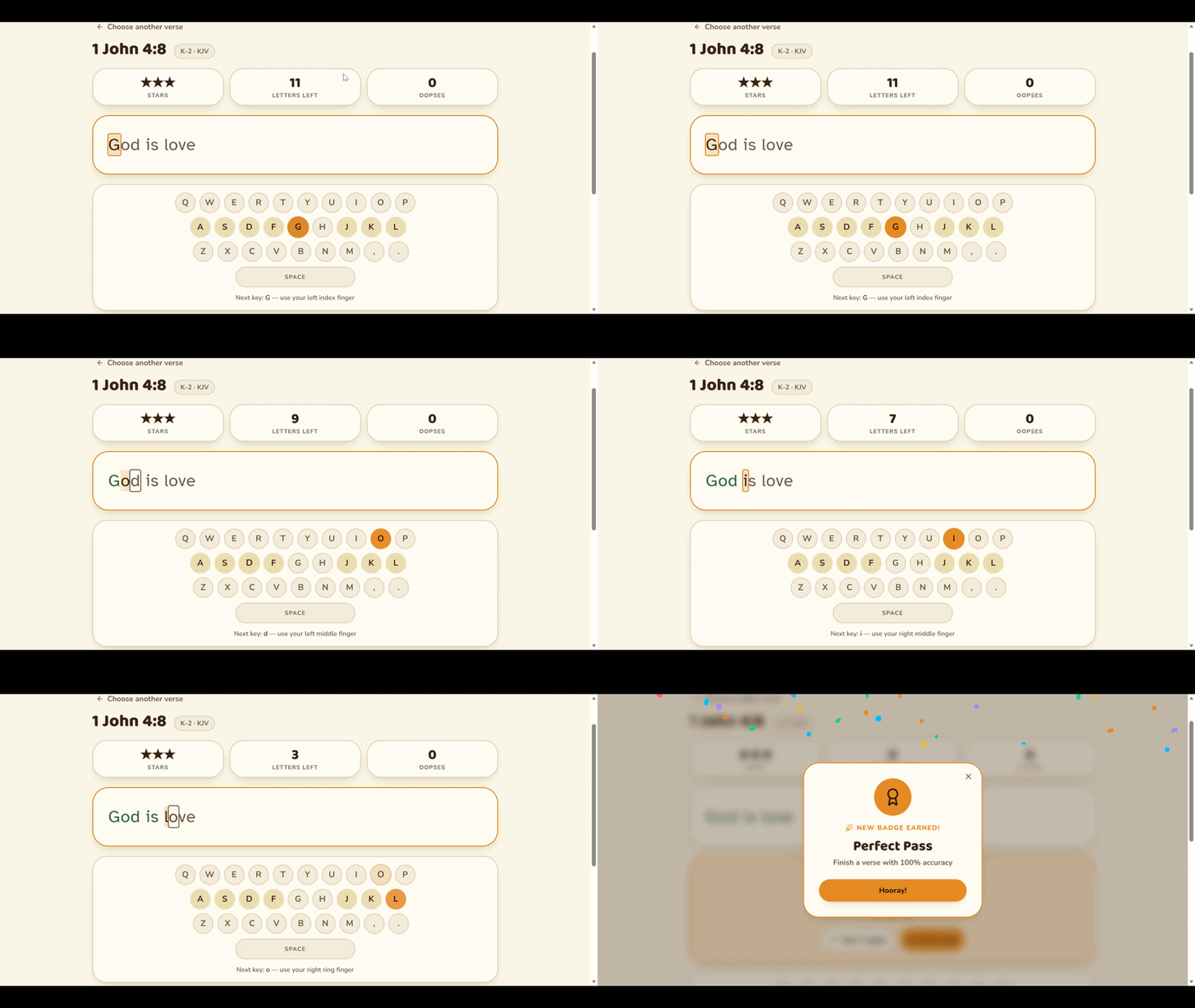
This is a great age to add a skill-based elective. Our free Bible typing lessons combine keyboarding practice with Scripture memory — two subjects in fifteen minutes.
Sample homeschool schedule: Middle school (grades 7–8)
| Time | Activity |
|---|---|
| 7:30 | Breakfast, chores, get dressed |
| 8:15 | Bible and journaling |
| 8:45 | Math |
| 9:45 | Language arts: writing and literature |
| 10:45 | Break |
| 11:00 | Science (Mon/Wed) or history (Tue/Thu) |
| 12:00 | Lunch |
| 1:00 | Foreign language or elective |
| 1:45 | Independent work, projects, reading |
| 3:00 | Done — sports, jobs, hobbies, friends |
Sample homeschool schedule: High school (grades 9–12)
High schoolers should own their schedule — your job shifts to weekly check-ins.
| Time | Activity |
|---|---|
| 8:00 | Breakfast and morning routine |
| 8:30 | Math |
| 9:30 | English / writing |
| 10:30 | Break |
| 10:45 | Science or history |
| 11:45 | Lunch |
| 12:30 | Foreign language or elective |
| 1:15 | Dual enrollment course work, CTE, or independent study |
| 2:30 | Job, internship, sports, or clubs |
Arizona homeschoolers can take community college courses through dual enrollment — see our dual enrollment guide for how credits transfer and how ESA interacts with it.
The four-day homeschool week
Many Arizona families — especially those in co-ops or hybrid programs — school four days and keep the fifth for co-op, field trips, or enrichment. To make it work: keep math and language arts daily (they build on themselves), double up history and science on their days, and protect the fifth day as genuinely different. Several Arizona hybrid schools and microschools run four-day weeks by design — browse homeschool co-ops and hybrid programs if you want that structure with community built in.
Block schedules vs. loop schedules
Two alternatives to the time-slot schedule, both more forgiving:
- Block schedule: instead of every subject every day, do longer blocks fewer times a week — math and language arts daily, history Mon/Wed, science Tue/Thu, electives Friday. Fewer transitions, deeper focus.
- Loop schedule: list subjects in order and simply do the next thing on the list each day, regardless of what day it is. A missed Tuesday doesn't break anything — the loop just continues. Ideal for families with babies, toddlers, or unpredictable weeks.
Rules that make any homeschool schedule work
- Schedule anchors, not minutes. "Math after breakfast" survives a bad morning; "math at 9:07" does not.
- Do the hardest subject first. Willpower is a morning resource.
- Start with a morning basket. One shared ritual (Bible, memory work, read-aloud) gathers everyone and starts the day on rails. For verse ideas, see our 30 Bible verses for kids to memorize.
- Plan for the sibling gap. If you have multiple kids, schedule the subject where the older child works independently while you teach the younger one, then swap.
- Quit on time. Ending at a consistent time teaches kids the day has a shape — and protects your afternoon.
- Review monthly, not daily. If a schedule fails three days in a row, the schedule is wrong, not the kids. Adjust the plan, not the children.
What about year-round homeschooling?
Arizona families commonly school year-round with breaks scattered through the year — popular in the desert because July and August are indoor months anyway, and October's perfect weather begs for field trips. A common pattern: six weeks on, one week off, with a longer break in December and June. The state doesn't care when you teach, only that you do.
Frequently asked questions
How many hours a day does homeschooling take?
Kindergarten takes about an hour of focused work; elementary 2–3 hours; middle school 3–4; high school 4–5. One-on-one instruction is far more efficient than a classroom, so homeschool days are much shorter than school days.
Does Arizona require a specific homeschool schedule or number of days?
No. Arizona law requires instruction in five subjects — reading, grammar, math, social studies, and science — but sets no required hours, days, or calendar. You choose the schedule, the start date, and the length of the year.
What time should homeschool start?
Whenever your family is at its best. Most families find a start between 8:00 and 9:00 works because mornings carry the most focus, but some families with teens shift academics to late morning or afternoon. Consistency matters more than the hour.
How do I homeschool with a baby or toddler in the house?
Use a loop schedule instead of time slots, teach the older child during naps, keep a box of toddler-only activities for school time, and accept that some days the loop barely moves. Short, consistent days beat long, interrupted ones.
Can I homeschool four days a week?
Yes. Keep math and language arts on all four days, concentrate history and science into longer blocks, and use the fifth day for co-op, field trips, sports, or enrichment. Many Arizona co-ops and hybrid programs are built around four-day weeks.
Should I use a printed planner or an app?
Whichever you'll actually look at. Paper planners work well for kids who check off their own lists; apps help parents juggling multiple children's assignments. Many families use a simple weekly checklist per child — it doubles as a record of work completed.
Frequently Asked Questions
How many hours a day does homeschooling take?▼
Does Arizona require a specific homeschool schedule or number of days?▼
What time should homeschool start?▼
How do I homeschool with a baby or toddler in the house?▼
Can I homeschool four days a week?▼
Should I use a printed planner or an app?▼
Part of the Laws & getting started hub
Arizona Homeschool Laws
The affidavit, ARS §15-802, required subjects, and how ESA changes your legal classification.
More from the Laws & getting started hub
- Homeschool vs. ESA in Arizona: Know the Legal Difference (2026)
Homeschooling (ARS §15-802) and ESA-funded education are two different legal pathways in Arizona. Here's how they differ, why it matters, and how to choose.
- Arizona Homeschool Laws: The Complete Guide for Christian Families (2026)
Arizona homeschool law explained for Christian families: the affidavit, the 30-day rule, required subjects, testing, ESA vs. homeschool, and returning to public school.
- How to Start Homeschooling in Arizona: The Complete Guide (2026)
Homeschooling in Arizona, step by step: the affidavit, ARS §15-802, the five required subjects, ESA funding of ~$7,000-$8,000, curriculum picks, and finding community.
- Arizona Homeschool Affidavit: 2026 Filing Guide
How to file the Arizona homeschool affidavit correctly: county-specific forms, the certified birth certificate rule, the 30-day deadline, and why ESA and affidavit are separate legal paths.
This guide is general information, not legal, tax, or financial advice. Confirm current rules with the Arizona Department of Education before acting.