Curriculum & Method
30 Bible Verses for Kids to Memorize (by Age and Theme)
30 short Bible verses for kids to memorize, grouped by age (preschool, elementary, middle school) and theme (courage, kindness, God's love) — plus simple memorization tips and a free Bible typing game.
9 min read · Updated
Updated October 23, 2026
Quick answer: The best Bible verses for kids are short, concrete, and easy to say out loud. For preschoolers, start with one-line verses like "Children, obey your parents in the Lord: for this is right" (Ephesians 6:1). For elementary ages, add verses about courage, kindness, and trust, like Joshua 1:9 and Philippians 4:13. Below are 30 kid-friendly verses grouped by age and theme, plus simple ways to help them stick.
All verses below are quoted from the King James Version (KJV), which is in the public domain, so you can freely print, copy, and share this list.
Free printables: Download our Bible verse coloring pages (10 verses in big outline letters kids can color) and Bible verse copywork sheets (trace the verse, then write it on handwriting lines). Both are free to print and share.
Prefer illustrated Bible stories? Our Bible verse coloring pages for kids guide includes a nine-page coloring book with Creation, Noah, Daniel, Jonah, and Jesus, plus page previews and printing tips.
The 10 best short Bible verses for kids
If you only pick a handful, start here. These are the shortest, most memorable verses on the list — perfect first memory verses.
- "Children, obey your parents in the Lord: for this is right." — Ephesians 6:1
- "Be ye kind one to another." — Ephesians 4:32
- "We love him, because he first loved us." — 1 John 4:19
- "I can do all things through Christ which strengtheneth me." — Philippians 4:13
- "Thy word is a lamp unto my feet, and a light unto my path." — Psalm 119:105
- "Trust in the Lord with all thine heart." — Proverbs 3:5
- "Rejoice evermore." — 1 Thessalonians 5:16
- "Be strong and of a good courage." — Joshua 1:9
- "Let all that you do be done with charity." — 1 Corinthians 16:14
- "Jesus wept." — John 11:35 (the shortest verse in the Bible — kids love that)
Bible verses for preschoolers (ages 2–5)
At this age, aim for verses under ten words. Say them at meals and bedtime, and celebrate repetition — not perfection.
- "In the beginning God created the heaven and the earth." — Genesis 1:1. Why it works: the very first sentence of the Bible, and a great answer to "who made that?"
- "Children, obey your parents in the Lord: for this is right." — Ephesians 6:1. Why it works: concrete and directly about their daily life.
- "Be ye kind one to another." — Ephesians 4:32. Why it works: five words that cover most sibling conflicts.
- "We love him, because he first loved us." — 1 John 4:19. Why it works: a gentle first answer to "why do we love God?"
- "Rejoice evermore." — 1 Thessalonians 5:16. Why it works: two words. Every preschooler can master it.
- "Jesus wept." — John 11:35. Why it works: the shortest verse in the Bible, and it shows kids that Jesus had real feelings.
Bible verses for elementary kids (ages 6–10)
Elementary kids can handle a full sentence and start connecting verses to situations — being scared, being left out, making a mistake.
- "Be strong and of a good courage; be not afraid, neither be thou dismayed: for the Lord thy God is with thee whithersoever thou goest." — Joshua 1:9. For the first day of school, a new team, or a dark bedroom.
- "I can do all things through Christ which strengtheneth me." — Philippians 4:13. For hard math, hard practices, and hard days.
- "Trust in the Lord with all thine heart; and lean not unto thine own understanding." — Proverbs 3:5. For when things don't make sense.
- "Thy word is a lamp unto my feet, and a light unto my path." — Psalm 119:105. A picture kids can see: a lamp lighting the next step, not the whole road.
- "And be ye kind one to another, tenderhearted, forgiving one another, even as God for Christ's sake hath forgiven you." — Ephesians 4:32 (full verse). The grown-up version of the preschool verse.
- "Let all that you do be done with charity." — 1 Corinthians 16:14. A one-line rule for everything from chores to friendships.
- "A soft answer turneth away wrath." — Proverbs 15:1. Remarkably practical on the playground.
- "This is the day which the Lord hath made; we will rejoice and be glad in it." — Psalm 118:24. A great morning verse.
Bible verses for middle schoolers (ages 11–13)
Older kids are ready for verses about identity, pressure, and choices.
- "Let no man despise thy youth; but be thou an example of the believers, in word, in conversation, in charity, in spirit, in faith, in purity." — 1 Timothy 4:12. The definitive answer to "you're just a kid."
- "Fear not: for I am with thee: be not dismayed; for I am thy God." — Isaiah 41:10. For anxiety, which peaks in these years.
- "And be not conformed to this world: but be ye transformed by the renewing of your mind." — Romans 12:2. For peer pressure.
- "Whether therefore ye eat, or drink, or whatsoever ye do, do all to the glory of God." — 1 Corinthians 10:31. A framework for every small decision.
- "The fear of the Lord is the beginning of wisdom." — Proverbs 9:10. For a student starting to ask big questions.
- "Delight thyself also in the Lord; and he shall give thee the desires of thine heart." — Psalm 37:4. For dreams and disappointments.
Verses by theme
When your child is afraid
- "What time I am afraid, I will trust in thee." — Psalm 56:3
- "Fear not: for I am with thee." — Isaiah 41:10
- "For God hath not given us the spirit of fear; but of power, and of love, and of a sound mind." — 2 Timothy 1:7
About kindness and friendship
- "Be ye kind one to another." — Ephesians 4:32
- "A friend loveth at all times." — Proverbs 17:17
- "Therefore all things whatsoever ye would that men should do to you, do ye even so to them." — Matthew 7:12 (the Golden Rule)
About obeying and honoring parents
- "Children, obey your parents in the Lord: for this is right." — Ephesians 6:1
- "Honour thy father and thy mother." — Exodus 20:12
- "My son, hear the instruction of thy father, and forsake not the law of thy mother." — Proverbs 1:8
About God's love
- "We love him, because he first loved us." — 1 John 4:19
- "For God so loved the world, that he gave his only begotten Son, that whosoever believeth in him should not perish, but have everlasting life." — John 3:16
- "The Lord is good to all: and his tender mercies are over all his works." — Psalm 145:9
How to help kids actually memorize verses
Lists are easy to find; getting verses into a child's long-term memory is the real work. What consistently works for homeschool families:
- One verse at a time. A verse a week is plenty. Repetition beats volume.
- Say it at anchor points. Attach the verse to something that already happens — breakfast, the car ride, bedtime.
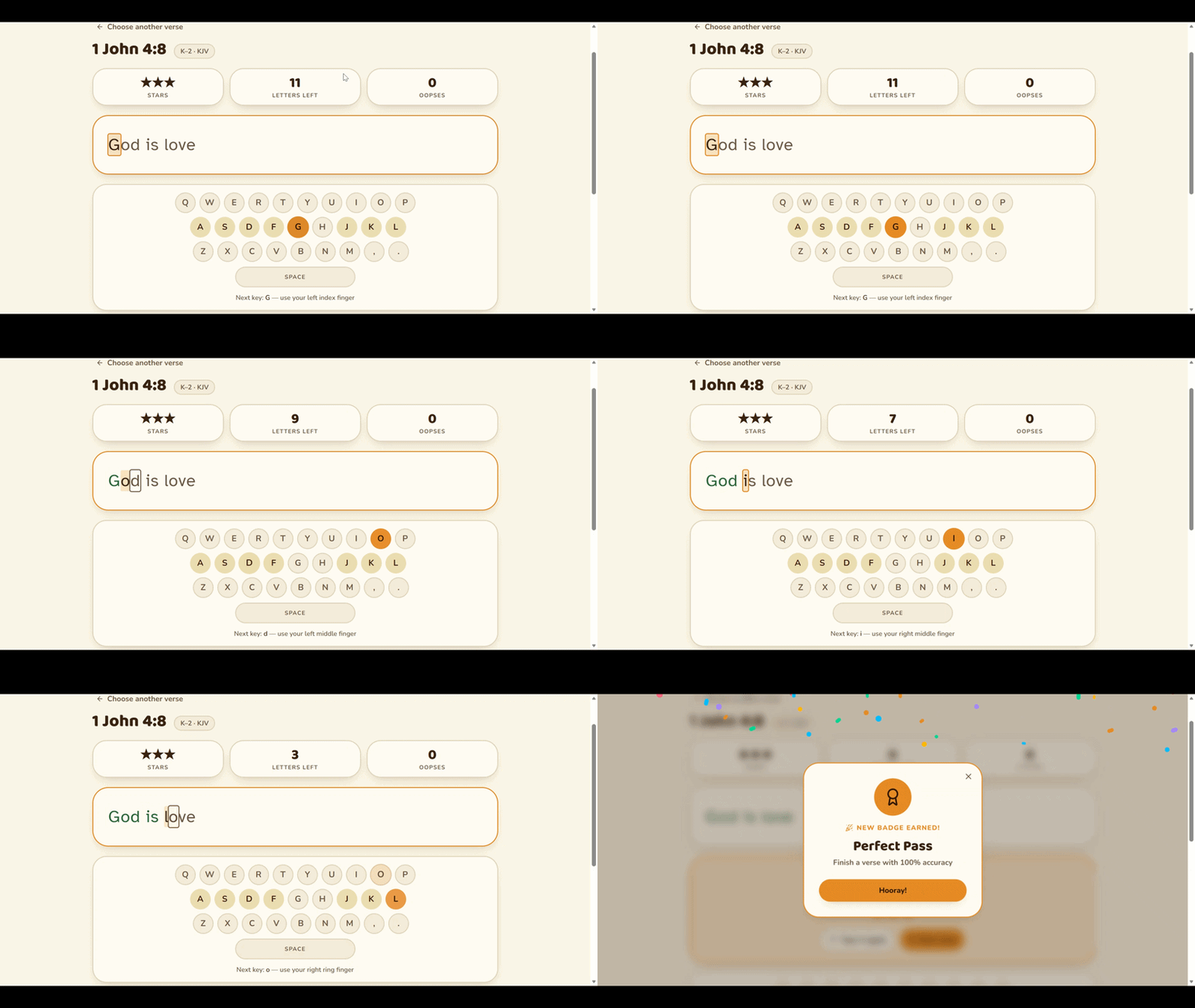
- Use their hands. Writing or typing a verse engages motor memory, not just hearing. Our free Bible typing lessons for kids turn memory verses into a typing game — children type the verse letter by letter, earn cheers as they go, and end up knowing it by heart without flashcards.
- Ask "what does it mean?" in one sentence. A verse a child can explain is a verse they keep.
- Review old verses weekly. A five-minute Friday review of everything learned so far is worth more than a new verse.
If you're building out a full Bible plan for your homeschool, see our guides to the best homeschool Bible curriculum and our 18-program Bible curriculum comparison. Arizona families should also know how ESA treats Bible materials — our ESA Bible curriculum guide explains what is and isn't fundable.
Frequently asked questions
What is a good first Bible verse for a child to memorize?
"Jesus wept" (John 11:35) is the shortest verse in the Bible and a fun first win. For a verse with more substance, "Children, obey your parents in the Lord: for this is right" (Ephesians 6:1) and "Be ye kind one to another" (Ephesians 4:32) are classic first memory verses.
How many verses should a child memorize in a year?
One verse per week is a sustainable pace — roughly 30 to 40 verses in a school year with review weeks. Consistency matters far more than speed.
Which Bible translation is best for kids?
For memorization, the best translation is the one your family actually reads. Shorter, rhythmic translations (like the KJV used here) are often easier to memorize; modern translations can be easier to understand. Many families memorize in one and read in another.
At what age can kids start memorizing Scripture?
Around age two or three, children can repeat short phrases like "Rejoice evermore." By age five or six, most kids can memorize full sentences. Start earlier than you think — young children memorize more easily than adults.
How do I make Bible memorization fun instead of a chore?
Keep sessions short, attach verses to routines, celebrate completions, and use movement or typing. Turning the verse into a game — like typing it letter by letter in our free typing lessons — works better than drills for most kids.
More programs in this guide
Frequently Asked Questions
What is a good first Bible verse for a child to memorize?▼
How many verses should a child memorize in a year?▼
Which Bible translation is best for kids?▼
At what age can kids start memorizing Scripture?▼
How do I make Bible memorization fun instead of a chore?▼
Part of the Curriculum & method hub
Christian Homeschool Curriculum Guides
Subject-by-subject and method-by-method guides to the curricula Arizona Christian homeschool families actually use — with ESA notes for each.
More from the Curriculum & method hub
- Charlotte Mason Curriculum: A Complete Guide for Christian Homeschool Families (2026)
What Charlotte Mason really is, whether it's Christian, the best CM curricula (Ambleside, Simply CM, My Father's World, Heart of Dakota), and how Arizona ESA funds apply.
- Generous Family Homeschool Curriculum Review (2026)
An honest review of the Generous Students Homeschool Edition from Generous Family: what's in the kit, how the 26-week schedule works, price, who it fits, and Arizona ESA/ClassWallet eligibility.
- Abeka vs BJU Press: An Honest Comparison for Christian Homeschoolers
Abeka vs BJU Press compared: teaching style, rigor, video options, cost, and Arizona ESA notes, plus the Arizona programs that use each.
- Abeka vs The Good and the Beautiful: Which Should You Choose?
Abeka vs The Good and the Beautiful compared for Christian homeschoolers: structure vs gentle open-and-go, cost, prep time, and Arizona ESA fit.
This guide is general information, not legal, tax, or financial advice. Confirm current rules with the Arizona Department of Education before acting.