Curriculum & Method
Books of the Bible in Order: All 66 (and 73 Catholic) Books
The complete list of the books of the Bible in order — 39 Old Testament and 27 New Testament books, with chapter counts, divisions, and the 7 Catholic deuterocanonical books clearly marked.
11 min read · Updated
Updated October 26, 2026
Quick answer: The Protestant Bible has 66 books — 39 in the Old Testament and 27 in the New Testament. It begins with Genesis and ends with Revelation. The Catholic Bible has 73 books — the same 66 plus 7 deuterocanonical books (Tobit, Judith, 1 Maccabees, 2 Maccabees, Wisdom, Sirach, and Baruch), all in the Old Testament. Catholic Bibles also include longer versions of Esther and Daniel. Both traditions share the same 27 New Testament books in the same order.
Every book that appears only in Catholic Bibles is marked with ✠ Catholic below.
| Protestant Bible | Catholic Bible | |
|---|---|---|
| Old Testament books | 39 | 46 |
| New Testament books | 27 | 27 |
| Total books | 66 | 73 |
| Old Testament chapters | 929 | 929 + deuterocanonical chapters and additions |
| New Testament chapters | 260 | 260 |
Old Testament books in order
This is the standard order used in English Protestant Bibles (KJV, NIV, ESV, NKJV, NASB, CSB). The ✠ Catholic rows show where the deuterocanonical books sit in Catholic Bibles such as the NABRE, RSV-CE, and Douay-Rheims.
| # | Book | Division | Chapters | In which Bibles |
|---|---|---|---|---|
| 1 | Genesis | Law (Pentateuch) | 50 | All |
| 2 | Exodus | Law (Pentateuch) | 40 | All |
| 3 | Leviticus | Law (Pentateuch) | 27 | All |
| 4 | Numbers | Law (Pentateuch) | 36 | All |
| 5 | Deuteronomy | Law (Pentateuch) | 34 | All |
| 6 | Joshua | History | 24 | All |
| 7 | Judges | History | 21 | All |
| 8 | Ruth | History | 4 | All |
| 9 | 1 Samuel | History | 31 | All |
| 10 | 2 Samuel | History | 24 | All |
| 11 | 1 Kings | History | 22 | All |
| 12 | 2 Kings | History | 25 | All |
| 13 | 1 Chronicles | History | 29 | All |
| 14 | 2 Chronicles | History | 36 | All |
| 15 | Ezra | History | 10 | All |
| 16 | Nehemiah | History | 13 | All |
| — | Tobit | History | 14 | ✠ Catholic only |
| — | Judith | History | 16 | ✠ Catholic only |
| 17 | Esther | History | 10 | All (Catholic Bibles include additional passages) |
| — | 1 Maccabees | History | 16 | ✠ Catholic only |
| — | 2 Maccabees | History | 15 | ✠ Catholic only |
| 18 | Job | Poetry & Wisdom | 42 | All |
| 19 | Psalms | Poetry & Wisdom | 150 | All |
| 20 | Proverbs | Poetry & Wisdom | 31 | All |
| 21 | Ecclesiastes | Poetry & Wisdom | 12 | All |
| 22 | Song of Solomon (Song of Songs) | Poetry & Wisdom | 8 | All |
| — | Wisdom (Wisdom of Solomon) | Poetry & Wisdom | 19 | ✠ Catholic only |
| — | Sirach (Ecclesiasticus) | Poetry & Wisdom | 51 | ✠ Catholic only |
| 23 | Isaiah | Major Prophets | 66 | All |
| 24 | Jeremiah | Major Prophets | 52 | All |
| 25 | Lamentations | Major Prophets | 5 | All |
| — | Baruch | Major Prophets | 6 | ✠ Catholic only (chapter 6 is the Letter of Jeremiah) |
| 26 | Ezekiel | Major Prophets | 48 | All |
| 27 | Daniel | Major Prophets | 12 | All (Catholic Bibles have 14 chapters, adding Susanna, Bel and the Dragon, and the Prayer of Azariah) |
| 28 | Hosea | Minor Prophets | 14 | All |
| 29 | Joel | Minor Prophets | 3 | All |
| 30 | Amos | Minor Prophets | 9 | All |
| 31 | Obadiah | Minor Prophets | 1 | All |
| 32 | Jonah | Minor Prophets | 4 | All |
| 33 | Micah | Minor Prophets | 7 | All |
| 34 | Nahum | Minor Prophets | 3 | All |
| 35 | Habakkuk | Minor Prophets | 3 | All |
| 36 | Zephaniah | Minor Prophets | 3 | All |
| 37 | Haggai | Minor Prophets | 2 | All |
| 38 | Zechariah | Minor Prophets | 14 | All |
| 39 | Malachi | Minor Prophets | 4 | All |
Note on names: Some Catholic Bibles use older names — for example, the Douay-Rheims calls 1–2 Samuel "1–2 Kings," calls 1–2 Kings "3–4 Kings," and 1–2 Chronicles "1–2 Paralipomenon." The books are the same; only the titles differ. Joel and Malachi are also divided into chapters slightly differently in some Bibles.
New Testament books in order
The New Testament is identical in Protestant, Catholic, and Orthodox Bibles: 27 books, in the same order.
| # | Book | Division | Chapters | Traditional author |
|---|---|---|---|---|
| 1 | Matthew | Gospels | 28 | Matthew |
| 2 | Mark | Gospels | 16 | Mark |
| 3 | Luke | Gospels | 24 | Luke |
| 4 | John | Gospels | 21 | John |
| 5 | Acts | History | 28 | Luke |
| 6 | Romans | Paul's Letters | 16 | Paul |
| 7 | 1 Corinthians | Paul's Letters | 16 | Paul |
| 8 | 2 Corinthians | Paul's Letters | 13 | Paul |
| 9 | Galatians | Paul's Letters | 6 | Paul |
| 10 | Ephesians | Paul's Letters | 6 | Paul |
| 11 | Philippians | Paul's Letters | 4 | Paul |
| 12 | Colossians | Paul's Letters | 4 | Paul |
| 13 | 1 Thessalonians | Paul's Letters | 5 | Paul |
| 14 | 2 Thessalonians | Paul's Letters | 3 | Paul |
| 15 | 1 Timothy | Paul's Letters | 6 | Paul |
| 16 | 2 Timothy | Paul's Letters | 4 | Paul |
| 17 | Titus | Paul's Letters | 3 | Paul |
| 18 | Philemon | Paul's Letters | 1 | Paul |
| 19 | Hebrews | General Letters | 13 | Unknown (author not named) |
| 20 | James | General Letters | 5 | James |
| 21 | 1 Peter | General Letters | 5 | Peter |
| 22 | 2 Peter | General Letters | 3 | Peter |
| 23 | 1 John | General Letters | 5 | John |
| 24 | 2 John | General Letters | 1 | John |
| 25 | 3 John | General Letters | 1 | John |
| 26 | Jude | General Letters | 1 | Jude |
| 27 | Revelation | Prophecy | 22 | John |
"Traditional author" reflects long-standing church tradition; scholars debate the authorship of some books.
The books of the Bible by division
Learning the books in groups is far easier than memorizing 66 names in a row. Here is the whole Bible in ten divisions.
Old Testament
- The Law (Pentateuch) — 5 books: Genesis, Exodus, Leviticus, Numbers, Deuteronomy. Creation, the patriarchs, the Exodus from Egypt, and the giving of the Law at Sinai.
- History — 12 books: Joshua, Judges, Ruth, 1 & 2 Samuel, 1 & 2 Kings, 1 & 2 Chronicles, Ezra, Nehemiah, Esther. Israel enters the Promised Land, becomes a kingdom, goes into exile, and returns. ✠ Catholic Bibles add Tobit, Judith, 1 Maccabees, and 2 Maccabees.
- Poetry & Wisdom — 5 books: Job, Psalms, Proverbs, Ecclesiastes, Song of Solomon. Worship, suffering, wise living, and love. ✠ Catholic Bibles add Wisdom and Sirach.
- Major Prophets — 5 books: Isaiah, Jeremiah, Lamentations, Ezekiel, Daniel. "Major" means longer, not more important. ✠ Catholic Bibles add Baruch.
- Minor Prophets — 12 books: Hosea, Joel, Amos, Obadiah, Jonah, Micah, Nahum, Habakkuk, Zephaniah, Haggai, Zechariah, Malachi. Shorter prophetic books, called "The Twelve" in the Hebrew Bible.
New Testament
- Gospels — 4 books: Matthew, Mark, Luke, John. The life, death, and resurrection of Jesus.
- History — 1 book: Acts. The birth and spread of the early church.
- Paul's Letters — 13 books: Romans through Philemon. Written to churches and individuals.
- General Letters — 8 books: Hebrews, James, 1 & 2 Peter, 1, 2 & 3 John, Jude. Written to wider audiences. (Some traditions count Hebrews among Paul's letters, giving 14 Pauline and 7 general letters — Catholics often call these seven the "Catholic Epistles.")
- Prophecy — 1 book: Revelation. John's vision of the end of the age and the new creation.
Why do Catholic and Protestant Bibles have different books?
The difference is entirely in the Old Testament.
- The Hebrew Bible used by Jews contains the same content as the Protestant Old Testament (39 books in Protestant counting, grouped as 24 in Jewish counting).
- The Septuagint, a Greek translation used widely by Greek-speaking Jews and early Christians, included additional books and passages — the ones Catholics call deuterocanonical ("second canon").
- The Latin Vulgate (Jerome, around AD 400) included these books, and they were read in the Western church for over a thousand years.
- During the Reformation, Martin Luther and other Protestant reformers followed the Hebrew Bible's list for the Old Testament. Luther's 1534 Bible placed the extra books in a separate section titled "Apocrypha" — useful to read, but not equal to Scripture. The original 1611 King James Version also printed the Apocrypha between the testaments.
- The Council of Trent (1546) formally affirmed the 73-book canon for the Catholic Church.
"Deuterocanonical" vs. "Apocrypha": Catholics use deuterocanonical for the seven books they accept as Scripture. Protestants usually call the same books the Apocrypha. Eastern Orthodox Bibles include all of these plus a few more (such as 1 Esdras, the Prayer of Manasseh, 3 Maccabees, and Psalm 151), so Orthodox Bibles have more than 73 books depending on the tradition.
Are the books of the Bible in chronological order?
No. The books are arranged by type (law, history, poetry, prophecy, gospels, letters), not by when they were written or when events happened. A few examples:
- Job is placed in the poetry section, but many readers believe its events took place around the time of the patriarchs — before Exodus.
- The prophets (Isaiah–Malachi) preached during the period described in 2 Kings, 2 Chronicles, Ezra, and Nehemiah.
- Paul's letters are ordered roughly from longest to shortest, not by date. Many scholars think 1 Thessalonians or Galatians was written first.
- 1 & 2 Chronicles retell much of the history of Samuel and Kings from a different angle.
If you want to read the story in the order it happened, use a chronological Bible reading plan.
Bible book facts at a glance
- Longest book: Psalms (150 chapters). By word count, Jeremiah is often listed as the longest.
- Shortest book: 3 John (by word count in the original Greek). 2 John has the fewest verses (13).
- Longest chapter: Psalm 119 (176 verses).
- Shortest chapter: Psalm 117 (2 verses).
- Shortest verse: "Jesus wept." (John 11:35)
- One-chapter books: Obadiah, Philemon, 2 John, 3 John, Jude.
- Books named after women: Ruth and Esther (and ✠ Judith in Catholic Bibles).
- Books with "1" and "2" (and "3"): Samuel, Kings, Chronicles, Corinthians, Thessalonians, Timothy, Peter, John (✠ and Maccabees).
How to memorize the books of the Bible
- Learn the divisions first. Know that there are five sections in the Old Testament (5–12–5–5–12) and five in the New (4–1–13–8–1). Then fill in each section.
- Chunk by fives. Genesis–Exodus–Leviticus–Numbers–Deuteronomy is one chunk. Isaiah–Jeremiah–Lamentations–Ezekiel–Daniel is another.
- Use the pairs. Samuel, Kings, Chronicles always come in twos and always in that order.
- Sing it. Many families learn the books with a simple song; melody makes long lists stick.
- Look it up. Play a "Bible drill": call out a book and race to find it. Kids learn the order fast when they handle a real Bible.
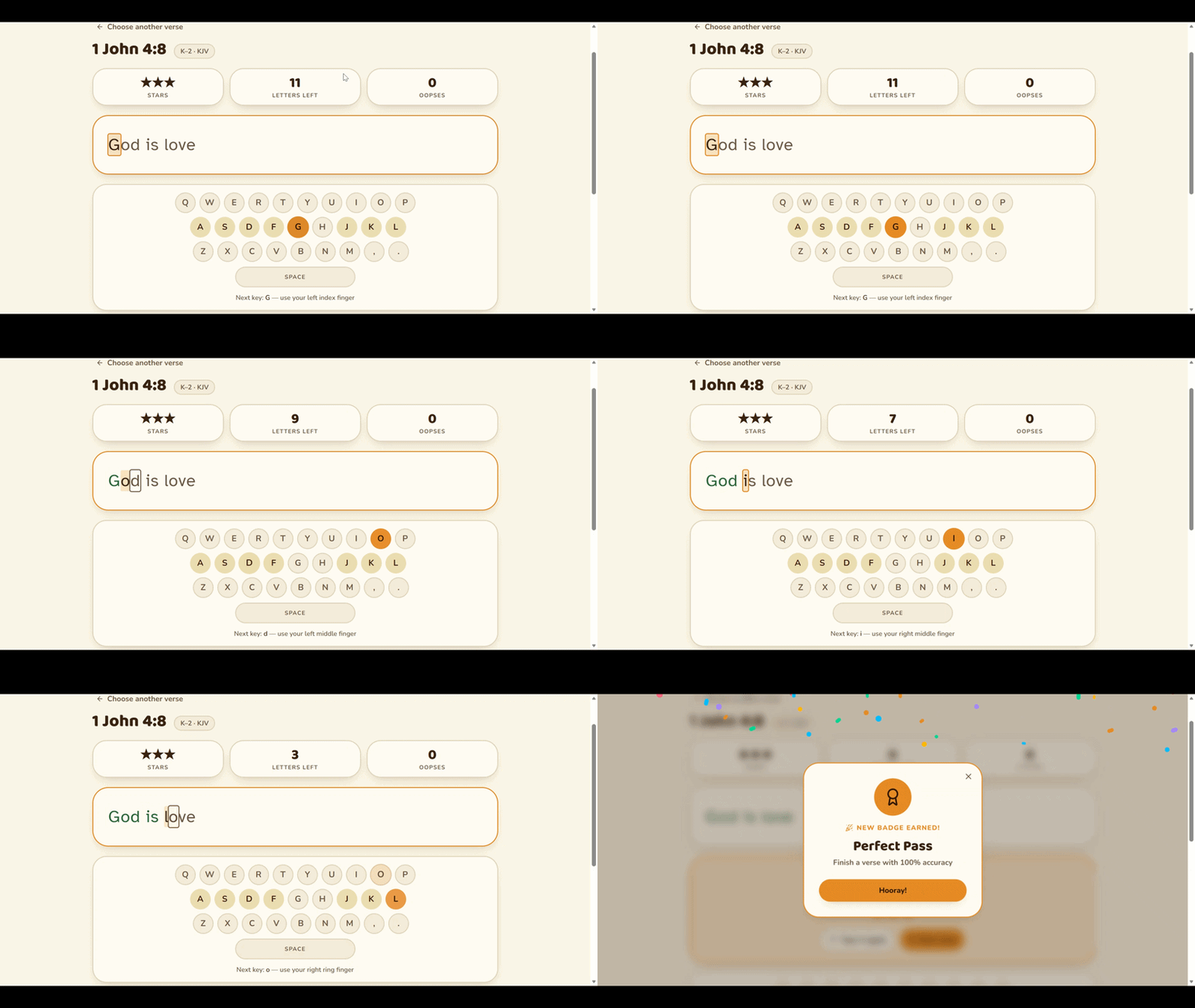
- Type it. Have kids type a verse from each book as they learn it with our free Bible typing lessons — they practice keyboarding while memorizing Scripture.
- Review weekly. Five minutes a week beats one long session a month.
For memory verses to pair with each book, see 30 Bible verses for kids to memorize.
Choosing a Bible curriculum for your homeschool
If you are teaching the books of the Bible at home, a structured Bible curriculum can help. Compare options in our homeschool Bible curriculum comparison and our list of the best homeschool Bible curriculum. Arizona families using ESA funds can review the ESA-approved Bible curriculum guide.
Sources
More programs in this guide
Frequently Asked Questions
How many books are in the Bible?▼
What are the 7 extra books in the Catholic Bible?▼
What is the first and last book of the Bible?▼
Are the books of the Bible in chronological order?▼
What is the longest and shortest book of the Bible?▼
Is the New Testament the same in Catholic and Protestant Bibles?▼
Part of the Curriculum & method hub
Christian Homeschool Curriculum Guides
Subject-by-subject and method-by-method guides to the curricula Arizona Christian homeschool families actually use — with ESA notes for each.
More from the Curriculum & method hub
- Charlotte Mason Curriculum: A Complete Guide for Christian Homeschool Families (2026)
What Charlotte Mason really is, whether it's Christian, the best CM curricula (Ambleside, Simply CM, My Father's World, Heart of Dakota), and how Arizona ESA funds apply.
- Generous Family Homeschool Curriculum Review (2026)
An honest review of the Generous Students Homeschool Edition from Generous Family: what's in the kit, how the 26-week schedule works, price, who it fits, and Arizona ESA/ClassWallet eligibility.
- Abeka vs BJU Press: An Honest Comparison for Christian Homeschoolers
Abeka vs BJU Press compared: teaching style, rigor, video options, cost, and Arizona ESA notes, plus the Arizona programs that use each.
- Abeka vs The Good and the Beautiful: Which Should You Choose?
Abeka vs The Good and the Beautiful compared for Christian homeschoolers: structure vs gentle open-and-go, cost, prep time, and Arizona ESA fit.
This guide is general information, not legal, tax, or financial advice. Confirm current rules with the Arizona Department of Education before acting.